Memorial Day weekend is a few days out, and this year the forecast is doing what Long Island forecasts love to do right when it matters: clouds moving in, showers likely Saturday through Monday, highs barely touching the low 70s. Not exactly the conditions anyone wants for a season opener. But for boatyard managers trying to push boats into the water before their customers’ patience runs out, a wet holiday weekend is the least of your problems if your hydraulic equipment hasn’t been properly looked at since October.
Most boatyards on Long Island run a thorough pre-season checklist: engine service, bottom paint, rigging, electrical systems. The usual sequence. What consistently gets pushed down the list, or skipped entirely, is the hydraulic equipment running the yard itself. The travel hoists. The boat lifts. The power steering on service vessels. These systems sat through a Long Island winter, which means they went through months of freeze-thaw cycling, temperature swings, and sitting idle under pressure, and most yards give them a visual glance and move on.
That works fine right up until it doesn’t.
The Part Nobody Talks About Until It Fails
Here’s what a hydraulic hose failure on a travel hoist actually costs a boatyard during peak launch season, and it has nothing to do with the price of the hose.
The hoist goes down. The boats scheduled for that day don’t go in. Customers who booked their slips three months ago, who have Memorial Day weekend plans that involve being on the water, are now standing in your yard with a problem that has become your problem. Every hour that machine sits idle during the last week of May is revenue that you cannot recover. It doesn’t roll over to next week. It’s gone.
Industry data puts hydraulic hose failure as the cause of roughly 37% of unscheduled hydraulic machine downtime. In a boatyard context, that number takes on a very specific shape. It’s not abstract downtime on a production line. It’s a 45-foot boat hanging over the water while someone figures out where to source a replacement hose and how long it’s going to take.
The other cost that doesn’t show up on any invoice is the customer relationship damage. A boatyard that misses a launch window during Memorial Day weekend doesn’t just deal with one unhappy customer. That customer talks to the four guys in the next row of the yard who are watching everything unfold. Word travels fast in a boatyard.
What Winter Actually Does to a Hydraulic System
Long Island winters are not particularly brutal by upstate or New England standards, but they are hard on hydraulic systems in a specific way. It’s not the sustained cold. It’s the cycling. Temperatures go below freezing overnight, climb back into the 40s or 50s during the day, and repeat that pattern dozens of times between December and March. Rubber hose compounds go through repeated contraction and expansion. Fittings do the same. The cumulative stress on both the hose material and the seals at connection points is real, and it doesn’t announce itself with an obvious crack or visible leak.
What it produces is micro-degradation. A hose that looks fine at a glance but has lost meaningful flexibility. Fittings that were re-torqued at some point because they were weeping, rather than replaced, and are now one season further along that same path. Industry data on this is pretty clear: re-torquing a leaking fitting leads to 15% more leaks over time compared to replacing it outright. Tightening it feels like a fix. It is not a fix.
The hoses that deserve the most attention on a travel hoist are the lines running along the top of the machine, because they are the most exposed and the most overlooked. They take UV, they take weather, they take the physical stress of the hoist’s range of motion across every lift and every haul. A crack in a suction line that develops up there does not just cause a failure. It causes a drop in flow and pressure through the pump, and depending on when it gives out, it can cause hydraulic fluid to spray down onto a customer’s boat mid-lift. That is a very different kind of conversation to have.
The USCG Compliance Piece That Often Gets Overlooked
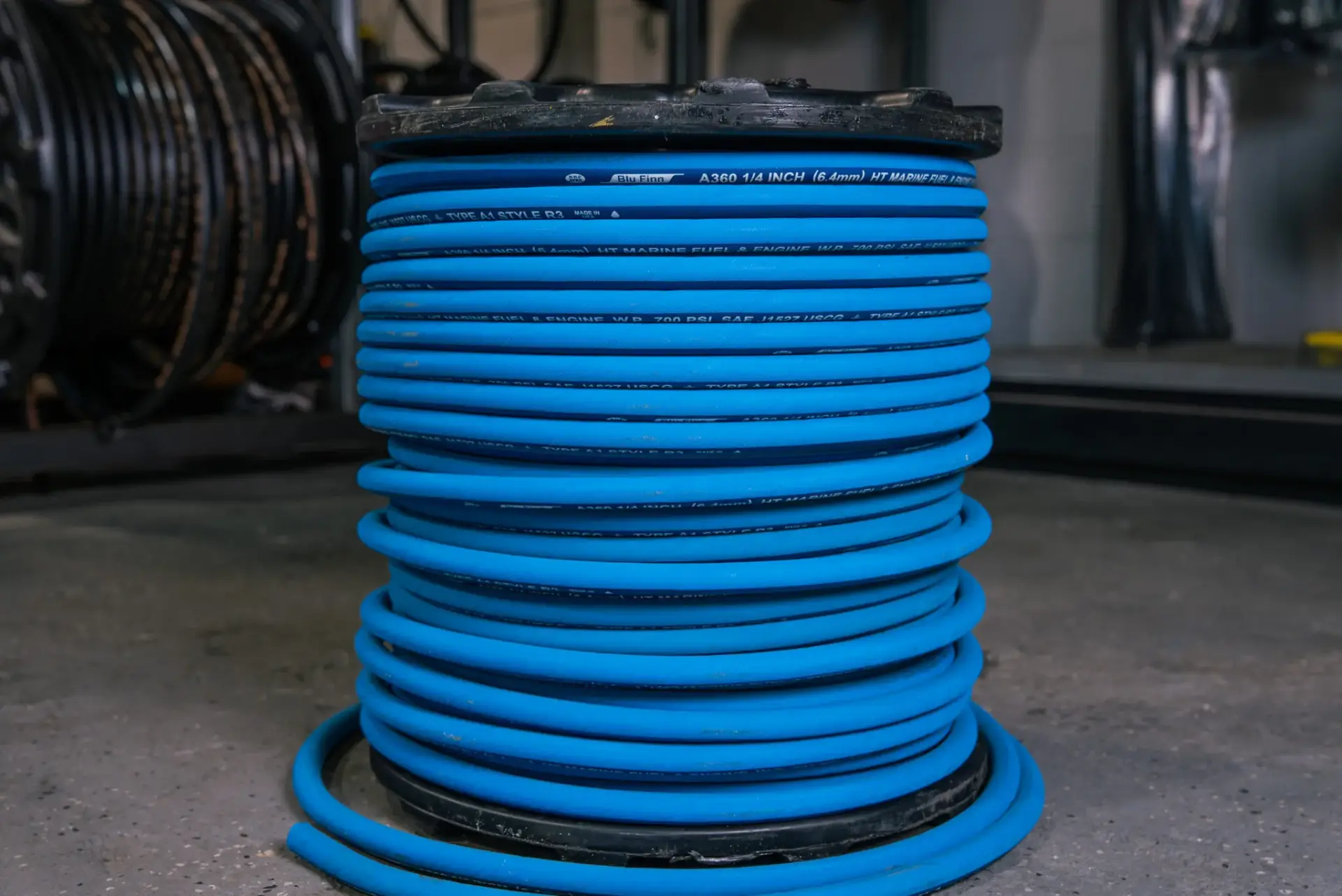
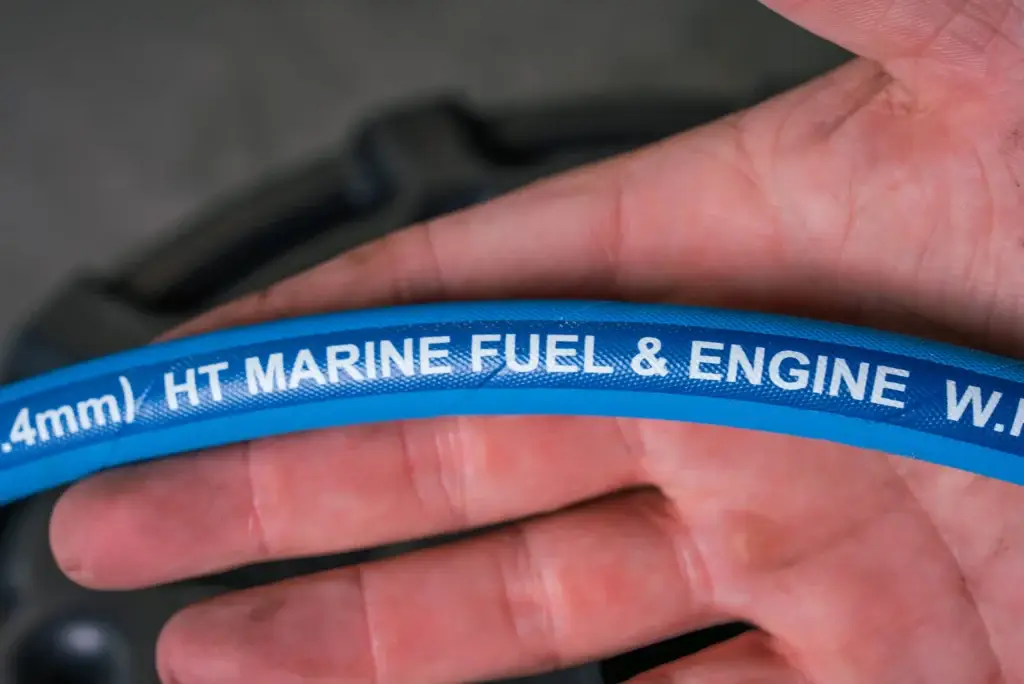
For boatyards handling fuel system work on customer vessels, there is a separate layer of hydraulic and marine hose responsibility that carries regulatory weight. USCG Type A1 J1527 approved hose is the standard for marine fuel and engine applications, and it exists because a fuel hose failure in an engine compartment is not a maintenance event. It is a fire event.
The U.S. Coast Guard has been active on fuel system standards recently. In January 2025, the ABYC published a revised H-24 Gasoline Fuel Systems standard and the USCG issued a policy accepting its requirements as equivalent to federal regulations under 33 CFR 183.566. The direction of travel is stricter permeation ratings and tighter compliance documentation, not looser.
Boatyards and marine service operations that are signing off on fuel system work on customer vessels need to be using compliant hose. Using aging marine fuel line that no longer meets spec, or substituting automotive-grade hose because it fits, creates a liability exposure that does not stay on the hose. It stays with the yard.
We stock USCG Type A1 J1527 approved Marine Fuel and Engine Hose with stainless steel fittings, ready for the 2026 season. More detail on what’s available is on our marine services page.
Getting the Right Hose When You Need It
One of the reasons hydraulic failures used to mean extended yard downtime was the sourcing problem. A non-standard length, an older fitting configuration on a travel hoist that’s been in service for fifteen years, a spec that no one nearby stocks. Those situations historically meant waiting a day or more for parts.
That is a solvable problem. At Long Island Hose, we build custom hydraulic hose assemblies while you wait, typically in minutes. The inventory covers the range of what marine and boatyard operations actually run: 1-wire and 2-wire braided hose, 4 and 6-spiral wire for high-pressure applications, thermoplastic, stainless PTFE, and a full selection of JIC, SAE, NPTF, O-ring face seal, BSP, and metric fittings. Details on the full range are on our hydraulic services page.
For yards that want to get ahead of in-season emergencies, our on-site inventory management program is built for exactly that situation. We assess your equipment, stock the right hoses and fittings at your location, and keep that inventory maintained so your crew has what they need without the drive.
When something does fail after hours, and it will at some point during a season, our 24/7 emergency service line is answered by someone who can actually help. Hydraulic failures in a working boatyard do not wait for 8 AM.
A Practical Pre-Season Check Before the Weekend Rush
Before the first major launch push, it is worth having someone walk through these specific points on all hydraulic yard equipment:
Look carefully at the hose lines on top of the travel hoist. Check for surface cracking, fading, abrasion wear, and any weeping at fittings. Note any fittings that were re-torqued previously and flag them for replacement rather than another round of tightening.
Run the hoist through a full operating cycle under no load and watch the system for any pressure hesitation, unusual noise, or slow response. Those are early signs of a developing problem that is much cheaper to address before a haul than during one.
Check hose age on high-use equipment. A staggered annual rotation, replacing the oldest hoses on the highest-use machines each pre-season, turns an unpredictable emergency into a planned maintenance cost.
Inspect marine fuel hose on any customer vessels receiving fuel system service before sign-off. Confirm USCG Type A1 J1527 compliance. If there is any question about what is currently installed on a vessel, that is the time to address it.
Memorial Day weekend will be what it will be, weather-wise. Cloudy, some showers, the usual Long Island spring unpredictability. But the operations that run the smoothest during the season opener are the ones that did the maintenance work in the weeks before, not the ones responding to failures during it.
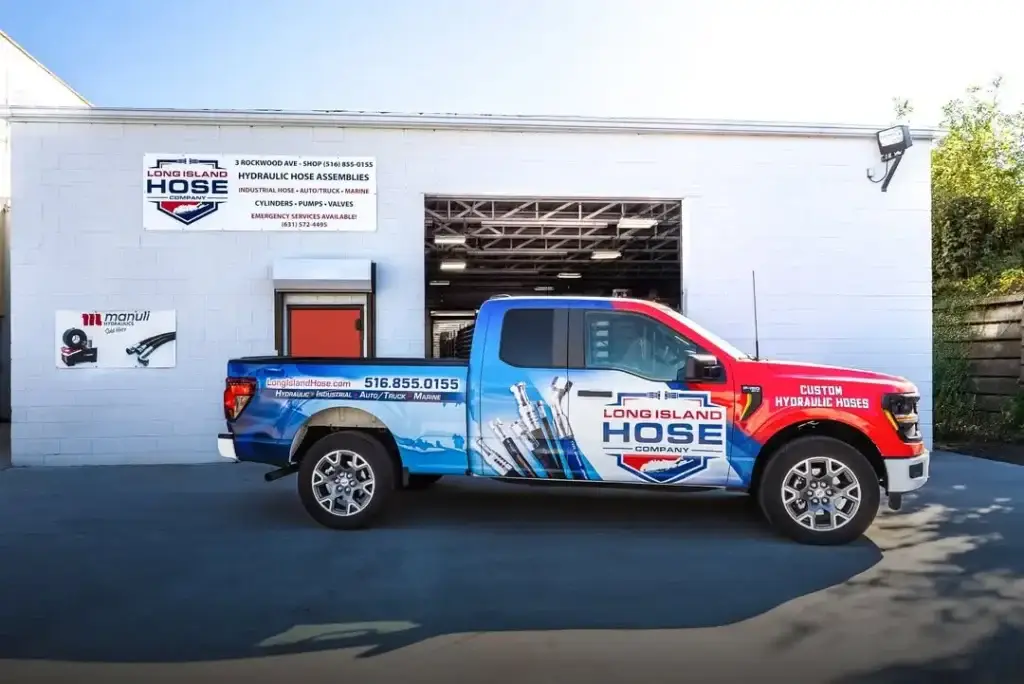
If you need hose, fittings, or a conversation about your yard’s hydraulic setup before the weekend, we are at 3 Rockwood Ave in Massapequa, open Monday through Friday 7:30 AM to 5 PM and Saturdays 8 AM to noon. Call the office at (516) 855-0155 or reach out through the contact page.
For a full look at what we carry and the services we offer, the services page covers it all.